NEWS ARTICLE ARCHIVESEnvironmentally sound bathrooms on college campuses use revolutionary XLERATOR Hand Dryer.
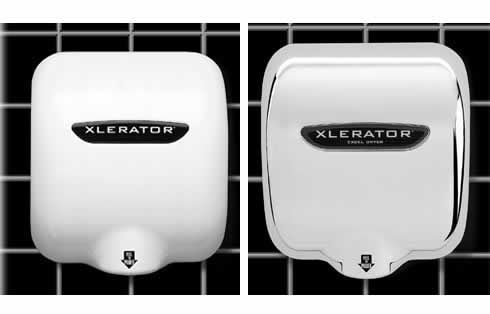
�Greening� the Student Union. Student Union at CalState Northridge leads the way towards hands-free, environmentally sound bathrooms on college campuses. Southern California is almost as well known for its environmental conscientiousness as it is for its frequent water shortages. In a part of the American landscape once dominated by arid desert, the now densely populated region has had to find new ways to preserve its important water resources. The University Student Union at California State Northridge has met this environmental challenge headon. Several of the newly-renovated Student Union buildings boast the most hands-free �green� state university bathrooms in the country. All of the University�s Student Union renovation projects in the last decade have been undertaken with environmental soundness and water preservation in mind, and the energy-saving measures have, not surprisingly, saved the University a great deal of money in the process. Gary Homesley, Assistant Director of Facilities and Maintenance at the Northridge University Student Union, says that the environmental initiative began with the former Assistant Director, Ray Miller � and they both agreed it was the logical thing to do. �After all,� says Homesley, �in the state of California it only makes sense to be water and landfill conscious.� Plus, they knew that an environmentally-friendly (and money-saving) student union complex would be a popular selling point for incoming students. �We�re a nonprofit organization, and this way, we let students know we care about their money. They�re very supportive of our efforts.� Together, Homesley and Miller discussed how best to achieve green standards and save money amidst budget cuts and other challenges to new development. Homesley knew that water preservation would be a major factor in cutting costs. �In California, you have to pay a sewer tax on all domestic water that you use,� he explains. �So, naturally, the less water you bring into a building and then waste in the sewer system, the fewer charges you incur.� To start, Homesley and Miller tested several waterless urinal systems to save water in the student union men�s rooms, both agreeing on the Waterless No-Flush� urinals from C&L Supply Company. These urinals work by draining fluid and trapping odors beneath a special sealant, which is poured into a small cartridge below the drain. The cartridge traps and filters out sediment, allowing an unobstructed flow of liquid down the drain without wasting water. The first building Homesley outfitted has 30 restrooms, 13 of which are men�s rooms with urinals. Once installed, the Waterless urinals alone accounted for a 35% reduction (around a million gallons per year) in domestic water intake that saved the university between $10-15,000 a year, depending on the annual cost of water. Homesley was pleased at the results and immediately started looking into other green fixtures: �Once we saw how effective the water-free urinals were at saving water and costs, we wondered, what next?� He installed hands-free faucets with automatic shut-off, automatic soap dispensers, and automatic flush toilets in all 30 restrooms. The automatic fixtures provided a more sanitary touch-free environment, as well as limiting the amount of water and soap product used. Next, Homesley decided to look at hand dryers. He wanted to reduce the $21,000 spent annually on paper towels, installation labor, and trash hauling fees. In addition to the expense of paper towels, the environmental impact of their manufacture is significant: to make one ton of recycled paper uses 7000 gallons of water, 360 gallons of oil, 158 million BTUs of energy, and releases 86 pounds of pollutants into the atmosphere. Homesley knew that he would have to limit paper use to achieve a truly green bathroom. However, he was skeptical. �I�d never liked hand dryers in the past,� Homesley said. �They never seemed to work well enough; your hands were never actually dry after using them.� Enter the XLERATOR� hand dryer. Researchers at Excel Dryer found that water clings to skin both as a thin film and as loose droplets. Instead of trying to evaporate the droplets, XLERATOR� blows them off using a focused high-velocity air stream and a specially designed nozzle. The high-velocity air also breaks up the layer of water vapor between the air and the skin. This causes the thin water film to evaporate more quickly than it would using a conventional dryer. Thus, it dries hands in about 15 seconds and uses 80% less energy than other dryers. �I was very impressed with these units,� confirms Homesley. �They are the best dryers I've ever seen, and one of the most energy efficient units on the market. I decided to get rid of all of our paper towels altogether." Homesley says that the cost of installing the urinals and dryers added up to about $24,900 total (all installation was done in-house with a fixed overhead). He started seeing significant savings due to water conservation within less than one year, and now estimates that the XLERATOR� and Waterless No-Flush� urinals save the Student Union more than $30,000 every year � money that used to be spent on water, paper towels, and associated labor and disposal fees. �The Union bathrooms generated about six tons of paper towel waste every year,� says Homesley. �It�s remarkable to be able to cut that out.� The student union now consists of 248,000 square feet on nine acres of property. Out of the seven present buildings comprising the complex, three boast bathrooms that incorporate as many LEED credit qualifying systems as possible. In Homesley�s view, the 30 bathrooms in the union building are now 100% green. They use only biodegradable toilet paper and no paper towels at all. They have significantly cut back on overall energy use. They replaced electrical water heaters in the building with natural gas, connecting directly to an existing central plant at the Student Union. All facilities were centralized wherever possible, rather than building new systems such as rooftop heating units. They use only efficient lighting such as energy watt and compact fluorescents, eliminating incandescent lamps wherever possible. All systems in the building � including air conditioning and lighting - are monitored electronically via photo and motion sensors. Homesley even limited much of the landscaping around the union building to native plants that don�t require much water. Homesley expects that, by the end of the fiscal year, two more buildings should be completed � and he plans to continue to adhere to strict green standards. �This has been a real whirlwind experience for us for the past few years,� he says. �We had a lot of success retrofitting the older buildings, once we tested and implemented suitable products; I expect to continue with this trend.� About California State University, Northridge: |
 |
 |
Home | About/Services | News Lounge | News Archive | Product Archive | Tender News | Testimonials | Conditions of Use | Privacy Policy


© 2022 SPEC-NET