NEWS ARTICLE ARCHIVESKelair's Viking pumps speed up road tanker transfer
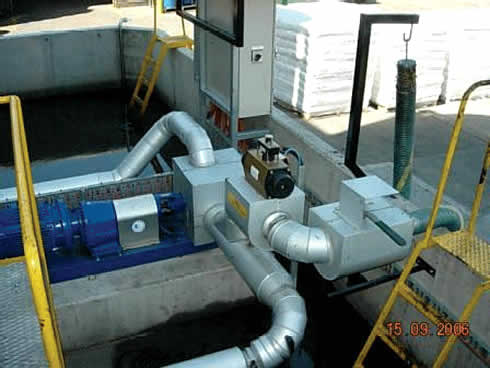
What's so special about road tanker unloading viscous fluids compared to normal pumping duties with viscous fluids? Speed! Normally our customers require the road tanker emptied in around one hour - less if possible as it's costly to have the tanker standing by for any length of time. So what is the difficulty with pumping viscous duties at speed? There is generally no difficulty with the pumping, once the right pump is selected. The difficulty lies in getting the fluid to the pump fast enough which means feeding the pump fast. If pumping is required faster than fluid can be drawn from the tanker, the pump will 'starve' for product, ending in cavitation, and with the tanker still being on-site for possibly another two to four hours. With viscous pumping, pipework is always important. This is exacerbated with road tanker unloading. For typical viscous fluid transfer from a permanentlylocated holding tank, the positive displacement pump should be situated directly under or close beside the tank. Suction pipework is typically relatively short with few bends and valves (and sometimes suction strainers with minimal losses). Road tankers on the other hand are usually parked a few metres from the pump. Flexible hoses to the suction end of the pump may be quite long and convoluted. Often 3" diameter hose is used, with bends and twists. As stated, if fast pumping is required, getting fluid to the pump just as fast is also required. The hoses may (all too often) have just too many frictional losses for viscous fluids. Working closely with one of our customers DIC Graphics Australia Pty Ltd, Kelair assisted with calculating fluid/pipe frictional losses from the road tanker to the pump's suction port. We advised what size pipework would allow the flow of liquid to pass freely, to 'support' the duty that the pump was required to perform and recommended a Viking 4124A model. Pictured above, the pump's duty is unloading a tanker full of viscous raw materials at viscosities to 2,000 cPs. The flexible hose was upsized to 4" diameter, larger than the usual 3". For OH&S reasons a chain support was installed to handle the weight of the hose when full. The viscosity and flowrate of the fluid dictated the maximum permissible length for the 4" diameter hose but it was too short to reach the tanker, so it was recommended a length of 6" diameter stainless steel line between the pump and the hose be included. The fluid passing through the 6" line would, of course, have the same flowrate as through the 4" hose, but at reduced velocity. Consequently, frictional losses are kept to a minimum, and the pump is able to be 'fed' fast enough. The road tankers arrive full at DIC Graphics. Within an hour or so, they leave empty, having pumped all their contents into the large storage tanks |
 |
 |
Home | About/Services | News Lounge | News Archive | Product Archive | Tender News | Testimonials | Conditions of Use | Privacy Policy


© 2022 SPEC-NET