

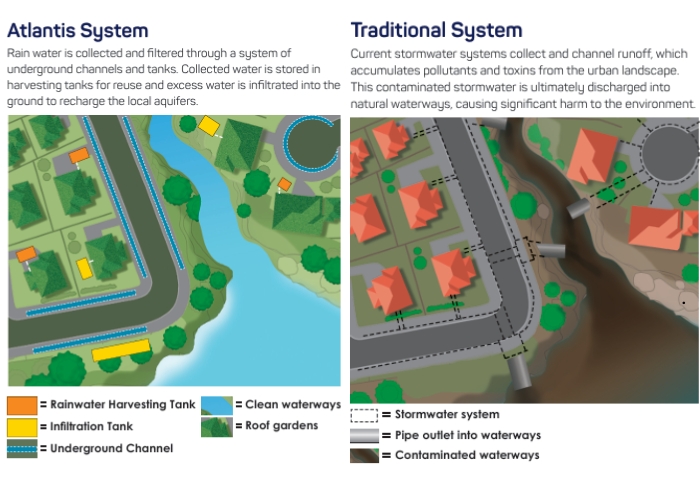
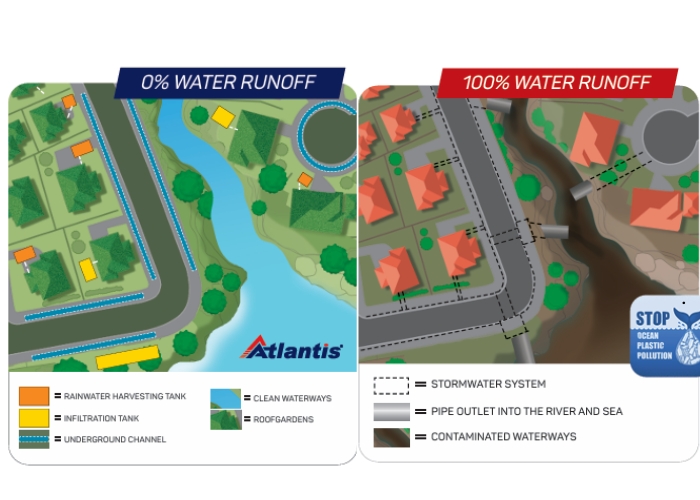
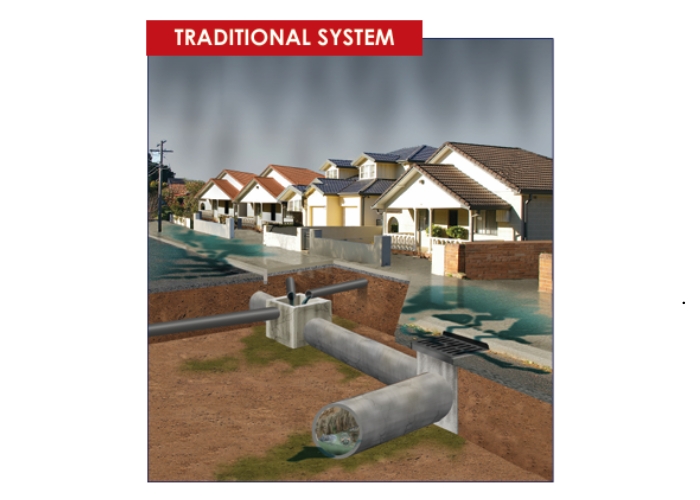
From Drainage to Water Management: A Necessary Shift in Urban Design For much of modern urban development, stormwater has been treated as a problem to be removed. The objective was simple: collect runoff and move it away from built areas as efficiently as possible. Pipes, culverts, and underground networks were designed to transport water downstream, minimising surface disruption and enabling rapid development. While this approach supported decades of urban growth, it is increasingly clear that it is no longer sufficient. Today, a shift is underway- one that redefines stormwater not as a nuisance, but as a resource to be managed. The Limits of a Drainage-First ApproachTraditional drainage systems are fundamentally linear.Rain falls - runoff is captured - water is conveyed - discharged downstream. This model prioritises speed and efficiency, but it does little to address the broader impacts of urbanisation on natural water cycles. As discussed in the previous article, this approach contributes to:
In highly urbanised catchments, simply improving conveyance capacity is no longer a viable long-term solution. Expanding pipe networks is costly, disruptive, and often impractical in built-up environments. More importantly, it does not address the root of the problem.Reframing Stormwater as a ResourceThe emerging perspective challenges a long-standing assumption: that stormwater should be removed as quickly as possible. Instead, designers and engineers are beginning to ask: How can stormwater be retained, used, and integrated within the site? This shift is not just philosophical- it has practical implications for how developments are planned and delivered. Stormwater, when managed effectively, can:
Rather than exporting water off-site, the goal becomes keeping it within the system for as long as possible, while maintaining safety and performance. The Rise of Water Sensitive Urban Design (WSUD)At the centre of this transition is the concept of Water Sensitive Urban Design (WSUD). WSUD promotes a more holistic approach to water management, integrating stormwater, groundwater, and water reuse into the planning and design of urban environments. Key principles include: 1. Source Control: Managing water where it falls, rather than relying solely on downstream infrastructure.2. Volume Reduction: Reducing total runoff, not just peak discharge rates. 3. Flow Attenuation: Slowing down water movement to mimic natural hydrological processes. 4. Water Quality Improvement: Filtering and treating stormwater before it enters natural systems. 5. Multi-Functional Design: Combining water management with landscape, recreational, and ecological outcomes. These principles represent a departure from isolated engineering solutions toward integrated system thinking. Design Implications for Modern ProjectsThis shift has direct consequences for how projects are conceived. Stormwater management is no longer a late-stage engineering exercise- it must be considered early in the design process, alongside architecture, landscape, and planning. Key changes include:
Projects that adopt this approach are better equipped to meet increasingly stringent regulatory requirements while delivering long-term performance benefits. Beyond Green vs Grey InfrastructureDiscussions around stormwater often frame solutions as a choice between "green" and "grey" infrastructure. In reality, the most effective outcomes typically involve a combination of both.
The challenge is not choosing one over the other- but integrating them intelligently. Enabling Smarter Water ManagementAs urban sites become more constrained, particularly in dense developments, the ability to manage stormwater within limited space becomes increasingly important. This is where adaptable, modular approaches are gaining attention. Systems that can:
Rather than relying solely on large, centralised infrastructure, these approaches support distributed, site-based management, aligning with the core principles of WSUD. A New Baseline for the IndustryWhat was once considered progressive is quickly becoming standard practice. Regulatory frameworks, particularly across Australia and other developed markets, are increasingly aligned with WSUD principles. Requirements for on-site detention, infiltration, and water reuse are no longer optional- they are expected. This signals a broader shift in the industry:
Looking AheadThe transition from drainage to water management is not a trend- it is a necessary evolution. As pressures on urban environments continue to grow, the projects that succeed will be those that treat water not as a liability, but as an asset. This requires a change in mindset, tools, and design processes- but it also presents an opportunity to create more resilient, efficient, and sustainable developments.The next step in this evolution is understanding where traditional solutions fall short- and why relying on detention alone is no longer enough. Visit atlantiscorporation.com.au for more information.
|
02 9417 8344 3/19-21 Gibbes Street, Chatswood, NSW, 2067
|
Related News Articles
 Space Is the New Constraint: Rethinking
 The Economics of Smarter Stormwater
 Green vs Grey Infrastructure: Why the
 Designing for Extreme Weather: Why
 Role of Modular Systems in Modern
 Infiltration: The Missing Piece in Urban
 Why Detention Alone Is Not the Solution
 The Hidden Crisis Beneath Our Cities:
 Green Wall System for Vertical Gardens
 Green Facade Architectural Screen System
 Drainage System for Sports Fields by
 Structural Soil for Urban Tree Growth by
 Vertical Gardens for Building Facades by
 Stable Grid for Equestrian Surface
 Vertical Wall Drainage Solution for
 Heavy Duty Underground Tank System by
 Subsurface Drainage for Tunnels and
 Stable Ground Reinforcement for
 Mini Water Storage Tank for Versatile
 Efficient Groundwater Filtering Strip
 |
 |
Home | About/Services | News Lounge | News Archive | Product Archive | Tender News | Testimonials | Conditions of Use | Privacy Policy | Stats


© SPEC-NET