

Infiltration: The Missing Piece in Urban Stormwater Design Detention systems, upgraded pipe networks, and discharge controls have all played an important role in reducing immediate flood risks. But despite these advancements, a critical component of the natural water cycle is still largely absent from many developments: Infiltration. What Urban Development Has DisruptedBefore urbanisation, rainfall followed a balanced path.A significant portion of water infiltrated into the ground, replenishing groundwater systems, supporting vegetation, and slowly moving through the soil profile before entering waterways. Only a small percentage became surface runoff. Urban development reverses this balance. With the introduction of impermeable surfaces such as roads, rooftops, and pavements:
Why Infiltration MattersInfiltration is not just a "nice to have" sustainability feature-it is a fundamental hydrological process.Reintroducing infiltration into urban design provides several key benefits: 1. Reduction in Runoff VolumeUnlike detention, which delays discharge, infiltration permanently removes a portion of stormwater from the runoff system.This directly reduces the load on downstream infrastructure. 2. Groundwater RechargeAllowing water to percolate into the soil helps restore groundwater levels, which are often depleted in urban environments.This is particularly important in regions where groundwater contributes to base flows in rivers and ecosystems. 3. Improved Water QualityAs stormwater passes through soil, natural filtration processes remove sediments, nutrients, and pollutants.This reduces the environmental impact of urban runoff entering natural waterways. 4. Healthier Urban LandscapesInfiltrated water supports vegetation, improving the performance of green infrastructure and enhancing urban microclimates. Why It's Often OverlookedDespite its benefits, infiltration is not always prioritised in stormwater design.There are several reasons for this: - Perceived Risk Concerns around soil conditions, groundwater contamination, or system performance can make designers hesitant. - Site Constraints Highly urbanised developments often have limited space, making traditional infiltration methods difficult to implement. - Design Complexity Infiltration requires a deeper understanding of:
This can add complexity compared to more standardised detention solutions. Regulatory FocusHistorically, many regulations have prioritised peak flow control over volume reduction, reinforcing detention-first approaches.Designing for Infiltration in Real-World Conditions While not every site is suitable for full infiltration, most developments can incorporate it to some degree. The key is to approach infiltration as part of a broader, integrated strategy. Considerations include:
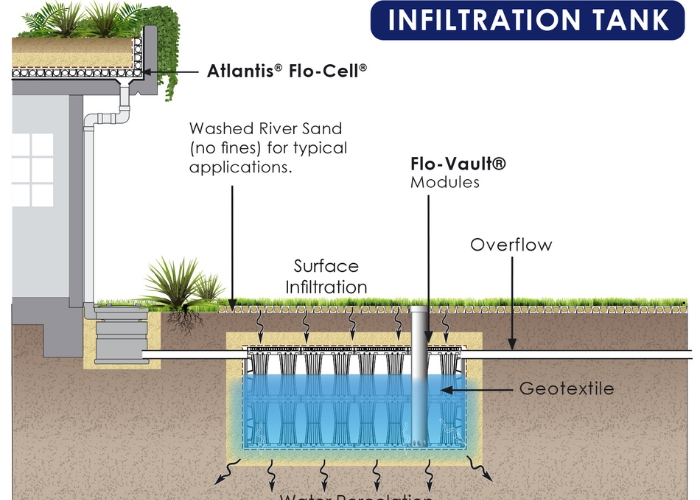
The Role of Engineered SolutionsIn constrained or complex sites, achieving effective infiltration often requires more than traditional surface-based methods.This is where engineered, below-ground systems can play a critical role. Modern solutions are designed to:
Rather than relying solely on natural soil exposure, these systems create controlled environments where infiltration can occur efficiently and predictably. They also allow infiltration to be implemented in locations where it would otherwise be impractical-such as beneath car parks, roads, or landscaped areas. Balancing Performance and PracticalityIt is important to recognise that infiltration is not a one-size-fits-all solution.Some sites may have:
However, even partial infiltration-combined with detention and reuse-can significantly improve overall system performance. The goal is not perfection, but progress toward restoring natural water balance. A Shift Toward Volume-Based ThinkingAs discussed in previous articles, the industry is moving beyond peak flow control toward a broader focus on runoff volume reduction.Infiltration is central to this shift. By removing water from the system entirely, it addresses one of the core limitations of traditional stormwater approaches. This aligns closely with evolving regulatory frameworks and sustainability targets, which increasingly recognise the importance of:
Looking AheadInfiltration is no longer an optional add-on-it is becoming a key component of modern stormwater design.As urban environments continue to densify, the challenge will be finding practical ways to integrate infiltration into increasingly constrained sites. This requires:
For more information, visit atlantiscorporation.com.au
|
02 9417 8344 3/19-21 Gibbes Street, Chatswood, NSW, 2067
|
Related News Articles
 Space Is the New Constraint: Rethinking
 The Economics of Smarter Stormwater
 Green vs Grey Infrastructure: Why the
 Designing for Extreme Weather: Why
 Role of Modular Systems in Modern
 Why Detention Alone Is Not the Solution
 From Drainage to Water Management: A
 The Hidden Crisis Beneath Our Cities:
 Green Wall System for Vertical Gardens
 Green Facade Architectural Screen System
 Drainage System for Sports Fields by
 Structural Soil for Urban Tree Growth by
 Vertical Gardens for Building Facades by
 Stable Grid for Equestrian Surface
 Vertical Wall Drainage Solution for
 Heavy Duty Underground Tank System by
 Subsurface Drainage for Tunnels and
 Stable Ground Reinforcement for
 Mini Water Storage Tank for Versatile
 Efficient Groundwater Filtering Strip
 |
 |
Home | About/Services | News Lounge | News Archive | Product Archive | Tender News | Testimonials | Conditions of Use | Privacy Policy | Stats


© SPEC-NET